
Natural Dog Supplements Without Synthetic Fillers
Quick Summary
Natural dog supplements are products whose vitamins, minerals and active ingredients come from food sources or naturally occurring materials rather than chemically synthesized compounds. The word "natural" describes origin, not guaranteed safety or effectiveness, so check the ingredient list, the dose per serving and the manufacturer's quality documentation.
- Check the ingredient list, the supplement facts panel and sourcing details before deciding on a product.
- Look for bulking agents, artificial colors and synthetic preservatives such as BHA, BHT and ethoxyquin.
- Compare the dose of each active per serving, since a short ingredient list can still underdose actives.
- Ask the manufacturer for a certificate of analysis, supplier identities and contaminant screening results.
- Consult your veterinarian before starting a supplement, especially for puppies, seniors, pregnant dogs or dogs on medication.
Table of Contents
- What Natural Dog Supplements Are and How They Differ From Synthetic Products
- How to Identify Synthetic Fillers, Preservatives and Additives on a Label
- Dog Supplement Ingredients to Avoid and Why They Matter
- Whole-Food Sources of Vitamins and Minerals for Everyday Wellness
- Supplements for Dogs on Homemade Food: When Gaps Matter
- Benefits, Realistic Expectations and Dosing by Size, Age and Health
- Booking Your Next Step: Check Labels, Ask Your Vet and Shop With Confidence
- Frequently Asked Questions
What Natural Dog Supplements Are and How They Differ From Synthetic Products
Natural dog supplements are products whose vitamins, minerals and other active ingredients come from food sources or naturally occurring materials, rather than from chemically synthesized compounds. The difference matters because the label "natural" does not, by itself, guarantee a product is safer or more effective. An estimated 10%-33% of dogs and cats are fed a pet supplement or nutraceutical, according to Veterinary Pet Supplements and Nutraceuticals review, so the category is widely used and worth understanding.
Here is the practical split. A whole-food supplement might list ingredients such as kelp, alfalfa or bone broth. A synthetic supplement typically lists isolated compounds made in a lab. Both can deliver a nutrient, but they differ in form, dose and how much else comes along with them.
Natural does not automatically outperform synthetic. The right choice generally depends on the dog's needs, the form of the ingredient and the dose, not on the origin alone. For a concise view of how this plays out in daily use, we recommend starting with the dog's diet and asking what, specifically, is missing.
How to Identify Synthetic Fillers, Preservatives and Additives on a Label
Reading a label is the fastest way to tell whether a product fits your standards, but most owners stop at the front of the package. The useful information sits in three places: the ingredient list, the guaranteed analysis or supplement facts panel, and the fine print about sourcing and manufacturing. Work through all three before you decide.
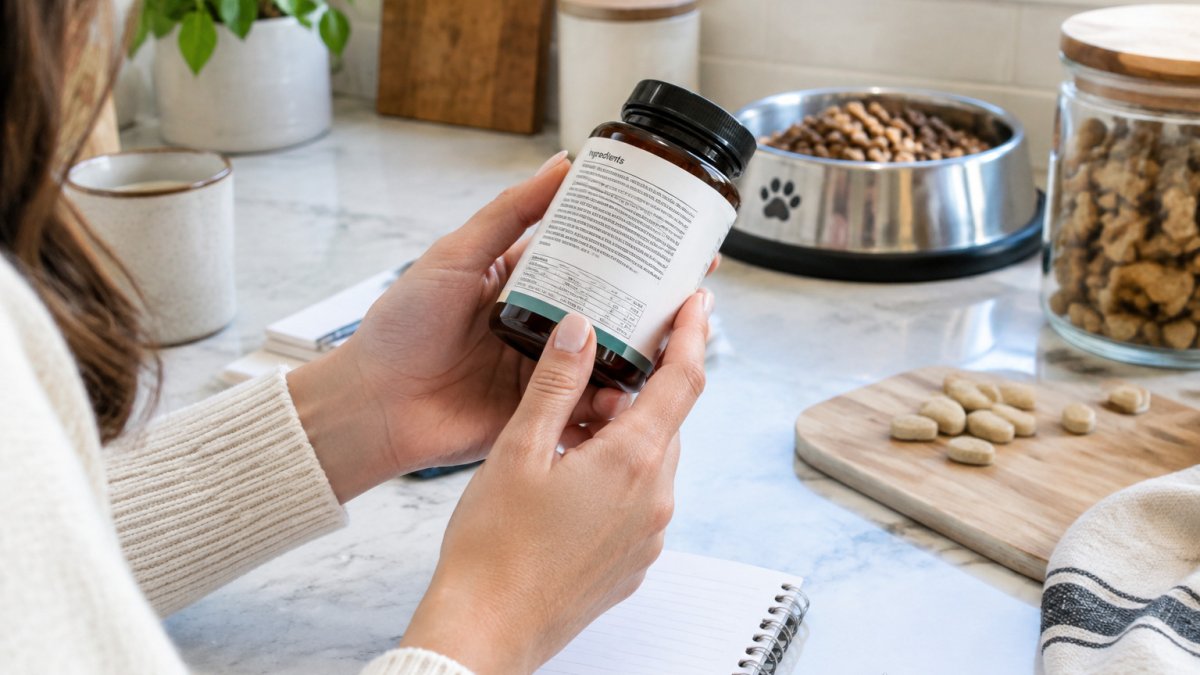
Start with the ingredient list, which is ordered by weight. Ingredients must be listed by their common or usual name, and each ingredient must be declared individually rather than lumped into a vague category. If a bulking agent, artificial colorant, or synthetic preservative appears near the top, it makes up a larger share of the product. If the list includes an unnamed "filler," "binder," or "flavor" with no source, treat that as a question to ask the manufacturer rather than a neutral entry.
An Ingredient-by-Ingredient Guide to Spotting Fillers
Use this three-pass checklist on any product you are considering.
Pass 1: Identify the actives and their sources. Confirm each active ingredient has a recognizable source, such as kelp, alfalfa, bone broth, fish oil, or a named vitamin premix. A named source is not proof of quality, but an unnamed one is a reason to keep reading.
Pass 2: Flag additives that only bulk, bind, color, or preserve. Common examples include:
- Bulking and binding agents: cellulose, maltodextrin, dextrose, cornstarch, wheat middlings, and various gums. These are not automatically harmful, but they dilute the active ingredients per serving and can matter for dogs with sensitivities.
- Artificial colors: entries such as FD&C Red No. 40, FD&C Yellow No. 5, and Blue No. 2. These exist to make the product look a certain way and add nothing nutritionally.
- Synthetic preservatives: BHA, BHT, ethoxyquin, and propyl gallate. Natural alternatives include mixed tocopherols and rosemary extract, though natural preservatives usually shorten shelf life.
- Artificial flavors and sweeteners: generic "animal digest," "artificial flavor," and sweeteners such as corn syrup or propylene glycol.
Pass 3: Compare dose per serving, not per container. Check the supplement facts or guaranteed analysis panel for the amount of each active per serving, then compare that number across products. A product with a short ingredient list can still underdose its actives, and a product with a longer list can still deliver a meaningful dose. The dose is what you are paying for.
Watch out: a short ingredient list is not proof of purity. Some products use few ingredients but still dilute actives with fillers, so always check the dose per serving against the label's serving size.
What "Natural" Does and Does Not Guarantee
The term "natural" describes origin rather than safety or effectiveness. The term also has a defined use in pet food labeling that centers on source and processing rather than on testing or clinical outcomes. Treat the word as a starting point, then verify the ingredient list, the dose, and the manufacturer's quality documentation yourself.
How to Verify Quality Beyond the Ingredient List
Label language is easy to print; documentation is harder to fake. Ask the manufacturer for three things: a certificate of analysis for the finished product, the identity of the ingredient suppliers, and confirmation of contaminant screening for heavy metals, mycotoxins, and microbials. Look for a named facility and a stated quality-control process rather than a generic "made in a GMP facility" line. If a company cannot answer basic sourcing questions, that is your answer.
Where to Draw Your Own Line
There is no single standard definition of a "clean" supplement, so you have to set your own standard. A practical approach is to decide in advance which additives you will accept (for example, natural preservatives) and which you will not (for example, artificial colors), then apply that standard consistently across brands. Write it down before you shop so marketing language does not move the line for you.
The article lists the common filler, colorant and preservative types to look for, and the dose-per-serving check that matters most.
| Additive type | Examples named in the article | What it does |
|---|---|---|
| Bulking and binding agents | Cellulose, maltodextrin, dextrose, cornstarch, wheat middlings | Dilutes active ingredients per serving |
| Artificial colors | FD&C Red No. 40, FD&C Yellow No. 5, Blue No. 2 | Adds appearance only, no nutrition |
| Synthetic preservatives | BHA, BHT, ethoxyquin, propyl gallate | Extends shelf life |
| Natural preservatives | Mixed tocopherols, rosemary extract | Natural option, usually shorter shelf life |
| Artificial flavors and sweeteners | Animal digest, artificial flavor, corn syrup, propylene glycol | Flavoring, no nutritional value |
Dog Supplement Ingredients to Avoid and Why They Matter
Some additives deserve scrutiny even in products marketed as wellness formulas. Artificial colorants add nothing nutritionally and exist mainly to make a product look a certain way. Synthetic fragrances and preservatives can be unnecessary for a supplement your dog takes daily. Whether they matter for your dog depends on his sensitivities, so discuss any specific concern with your veterinarian.
A common mistake is assuming that a product without a flavor or color is automatically clean. Check the whole label, not just the marketing front.
Whole-Food Sources of Vitamins and Minerals for Everyday Wellness
Many owners start by improving the diet before adding a supplement. Whole-food sources such as leafy greens, pumpkin, fish and organ meats provide vitamins and minerals alongside fiber, protein and other compounds. This food-based approach is often the simplest way to cover basic gaps.
Supplements can complement a balanced diet, but they should not replace one. Your veterinarian can help you decide whether food changes or a supplement, or both, make sense for your dog.
Supplements for Dogs on Homemade Food: When Gaps Matter
Dogs eating homemade diets can have nutrient gaps, because it is hard to balance every vitamin and mineral by hand. A supplement designed to fill those gaps can help, but only when it is matched to the specific deficiency and dose. Work with a veterinary nutritionist to build the recipe, then decide what supplement, if any, the plan needs.
Benefits, Realistic Expectations and Dosing by Size, Age and Health
Owners often hope for dramatic results, but supplements usually work gradually, if at all. Joint, skin, digestive, and immune support are the most common goals, and the evidence varies widely by ingredient. Setting realistic expectations before you buy is part of choosing well.
What the Evidence Supports, and Where It Is Thin
Some ingredients have meaningful veterinary and research support.
If you see no change after a fair trial at an appropriate dose, the supplement may not be the right fit, and it is worth revisiting the diet and a veterinary exam before adding another product.
A Cautious Dosing Framework by Size, Age, and Health Status
Dosing depends on your dog's weight, age, and health status, and there is no single formula that fits every product. Use this framework to structure the conversation with your veterinarian rather than to replace it.
- Weight: Dose scales with body weight for most ingredients, but not linearly for all of them. A small dog is not simply a fraction of a large dog for every nutrient, and some ingredients have upper limits that matter more for small dogs because the margin is narrower.
- Age: Puppies have different nutritional needs than adults and should not receive adult supplements without veterinary guidance, because excesses during growth can cause harm. Seniors often have reduced kidney and liver function, which changes how some ingredients are handled and makes dose review more important.
- Health status: Dogs with chronic conditions, dogs on medication, and dogs recovering from illness are the highest-risk group for interactions. Some supplements can interact with medications, so check with your veterinarian first. Confirm any supplement with your veterinarian before starting it in these dogs.
- Pregnancy and nursing: Avoid supplements not specifically cleared for breeding dogs, because safety data in this group is limited.
Watch out: never scale a dose from a human label or from a different product's label. The concentration of actives per serving varies widely between products, so the same number of milligrams can mean very different things.
When a Supplement Is Unnecessary or Should Not Replace Veterinary Care
A dog eating a complete and balanced diet may not need a supplement at all, and adding one can create imbalances rather than fix them. Supplements are also not a substitute for veterinary care. Symptoms such as limping, persistent scratching, vomiting, diarrhea, weight loss, or changes in thirst and urination warrant a veterinary exam, not a supplement trial. If your dog is already on a therapeutic diet or medication, treat any new supplement as a change that should be reviewed by your veterinarian first.
Tracking Results Without Fooling Yourself
Pick one or two specific outcomes before you start, such as willingness to climb stairs or the appearance of the coat, and note them at the start. Recheck at four and eight weeks. Because many conditions fluctuate on their own, a single good week is not proof, and a single bad week is not failure. A written log makes the decision to continue, adjust, or stop far more reliable than memory.
Booking Your Next Step: Check Labels, Ask Your Vet and Shop With Confidence
Start with the ingredient list and dose, then bring your questions to your vet. You can browse our shop our wellness and supplement range to read labels and compare products. Before you buy, check the planning steps in the essential dog health wellness checklist so your vet visits and home routine stay on track. Some readers also want to understand whether synthetic fragrances in pet products are a concern, which can help with label decisions.
For older dogs, our vet-informed guide to supplements for aging dogs covers dosing and safety in more depth.
Pawfect Supplies is here to help you choose with confidence, from label basics to shopping. Shop new arrivals now.
Frequently Asked Questions
What are the best natural supplements for dogs?
The best natural supplements depend on your dog's age, health and diet rather than one universal product. Look for products that list recognizable ingredients, name their sources and show a clear dose. You can check current pricing on our website or contact us for a quote. Confirm any choice with your veterinarian before starting.
How can I tell if a dog supplement contains synthetic fillers?
Read the full ingredient list and look for generic terms like "filler," artificial colors, synthetic preservatives such as BHA or BHT, and vitamins listed only by chemical name without a food source. Products that describe themselves as natural should still explain where their vitamins and minerals come from. The ingredient list matters more than the front label. A brand that is transparent about sourcing will usually state this clearly on its packaging or website.
Do dogs eating homemade food need vitamin and mineral supplements?
Many homemade diets are missing one or more nutrients, particularly calcium, vitamin E, zinc and iodine, unless the recipe was formulated by a veterinary nutritionist. A balanced recipe reduces the need for supplements, but it does not always eliminate it. Ask your veterinarian to review your recipe before adding a supplement, since too much of one nutrient can cause problems. Supplements designed for homemade-food dogs are usually a targeted addition rather than a full replacement.
Should I ask a veterinarian before giving my dog supplements?
Yes. Your veterinarian can confirm whether your dog needs a supplement at all, check for interactions with medications and recommend a dose appropriate for your dog's weight, age and health status. This is especially important for puppies, senior dogs, pregnant dogs and dogs with kidney, liver or heart conditions. Supplements should support veterinary care, not replace diagnosis or prescribed treatment.